
Child sponsorship has been an incredibly popular way of giving for decades, but recently, many international organizations have decided to pull out. In this article, I take a look at the mechanism of child sponsorship, and what your team might want to consider before you choose to quit cold turkey.
Here’s the thing… from a donor retention perspective, nothing beats child sponsorship. I know it might not be popular right now, but it keeps donors better than anything else on the market.
There, I said it.
Don’t get me wrong - as a model for community development, child sponsorship is far from perfect. I completely understand (and even support) the rationale behind migrating away from this decades-old mechanism. The ethical critiques are real. The operational burden is severe. The power dynamics between a donor in the Global North and a child in the Global South create genuine tension, especially when prioritizing the dignity and agency of the communities we are serving.
That said, I’m not entirely convinced that we, as a sector, have found anything equal or better to replace it with.
So, before we throw the baby out with the bath water, let’s talk about what child sponsorship actually got right, and the non-negotiables that Sponsorship 2.0 needs to deliberately preserve.
What child sponsorship did: Think about the classic child sponsorship appeal (and this is quite easy for me, since I spent half of my career at Christian Children’s Fund, which was once considered the world’s largest independent child care and development organization, and we pretty much originated the celebrity sponsorship appeal with Sally Struthers). The formula was specific and deliberate: a celebrity tells you about a child named Maria. Her age, where she lives, what her day looks like. And then, they’d hit you with the promise:
For less than your daily cup of coffee, you will help this specific girl. In return, you’ll get a photo, letters directly from Maria herself, an annual update showing you exactly what your donations are doing, the chance to send a gift on her birthday and at Christmas, the ability to meet her in person, if you choose.

Why it worked: That’s much more than good copywriting… it’s a contract with the donor. You do this and, in exchange, we do that. Donors knew exactly what they were signing up for. It was specific, tangible and deliverable. That clarity didn’t just drive acquisition. It was the foundation of retention. One led directly to the other. When you make a specific promise and keep it, donors stay. When you make a vague one - or don’t make one at all - they are more likely to leave.
What Sponsorship 2.0 must preserve: Stop being vague at acquisition. When someone becomes a monthly donor, tell them exactly what the relationship will look like. What will they receive? When? What can they expect from you? The standard monthly donor ask today doesn’t include a promise. No photo, no letters, no birthday cards, no commitment. Yes, the ask is simpler, but without the promise, there’s nothing holding the relationship together after the first gift.
What child sponsorship did: As a child sponsor, your donor wasn’t giving to “children in need.” They were giving to Maria. They knew her name, her age, where she lived, what she dreamed about. If your donor had faith, they likely prayed for Maria every day. And then something unexpected happened: they put her photo on their fridge. All of a sudden it wasn’t some child in a community far away… it was a real child who had become a part of their daily life. Every time the fridge opened, there was Maria. Every person who saw her photo learned something important about the sponsor: what mattered to them. That simple photo became an artifact of their giving, turning every sponsor into a passive brand ambassador - generating referrals with every conversation, without anyone asking them to.
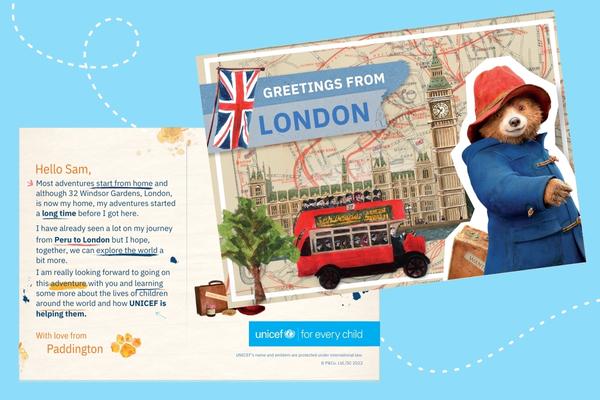
Why it worked: Specificity creates relationship. Relationship is sticky in a way that cause is not. Most organizations communicate at the level of a cause. Child sponsorship communicated at the level of a person. That difference is not subtle. Some organizations are already finding their way back to this insight. UNICEF's Paddington Bear postcard product does something child sponsorship always understood: it sends something physical into the donor's home that a real person (or in this case, a beloved character) has "written." The donor's children look forward to the next postcard. They show their friends. They ask their parents when the next one is coming. That's not a fundraising mechanic. That's a relationship.
What Sponsorship 2.0 must preserve: Find your organization’s equivalent of the fridge moment. What do you send your donors that they’d actually want to put somewhere, show someone, or talk about? A welcome pack mailed to their home (with a real photo, a handwritten note, something tactile) is a good start. It doesn’t have to be expensive, it just has to feel personal. The fridge photo generated referrals passively, at scale, for decades. That kind of word-of-mouth won’t happen by accident again. It happens when you give donors something worth talking about. Another example of an organization working to adapt child sponsorship is World Vision, who flipped the power dynamic completely in their campaign, Chosen. In this example, the child chooses the sponsor. The fridge moment is still there, just packaged in a new way.

What child sponsorship did: When it came to sponsored child communications, everything was run like a well-oiled machine. No matter who was on holiday, if the annual report was running behind, or if the programs team was understaffed, child letters, photos, birthday cards, and annual updates went out like clockwork. The touchpoint calendar was built into the sponsorship model itself.
Why it worked: In order to maintain a strong relationship between the sponsor and their child, nothing could be left to chance. The system was built around this communications calendar, and not the other way around. When the COVID19 pandemic hit, the infrastructure that had been so smoothly operating for decades largely stopped. Teams couldn’t travel into remote communities. Photos couldn’t be taken. Letters couldn’t be collected. The relationship had gone quiet, and the relationships weakened. Years later, many child sponsorship organizations are still looking at retention numbers that haven’t recovered, sitting on backlogs of unprocessed updates, unable to turn around the attrition numbers they’ve been seeing ever since. At CCFC (now Children Believe) we sent every new sponsor an education booklet explaining exactly what their communication journey would look like. The letter exchange diagram alone showed seven distinct steps across two countries and two translations. We weren’t just telling sponsors what to expect. We were showing them the infrastructure we’d built to make sure we’d never let them down.

What Sponsorship 2.0 must preserve: Decide on a communications schedule and build the systems to support it. The specific touchpoints matter less than the commitment to them. It doesn’t have to be birthday cards and annual reports, it just has to be something that you can follow through on every time… no compromise. Most donor communications are on someone’s to-do list, which makes them easy to shelve for another day. If you build the infrastructure around the schedule, you’ll never miss a touchpoint, and importantly, never break your promise.
What child sponsorship did: In a well-run child sponsorship program, donors were able to experience the complete results chain alongside the child they supported. They saw the inputs (their monthly gift), the outputs (new water projects, livelihoods trainings, classrooms being built) and the outcomes (better health, improved education) for the child, their family and - over time - the entire community. That’s Results-Based Management translated into donor language, proving their support was achieving results. And, it was built into the design from the start.
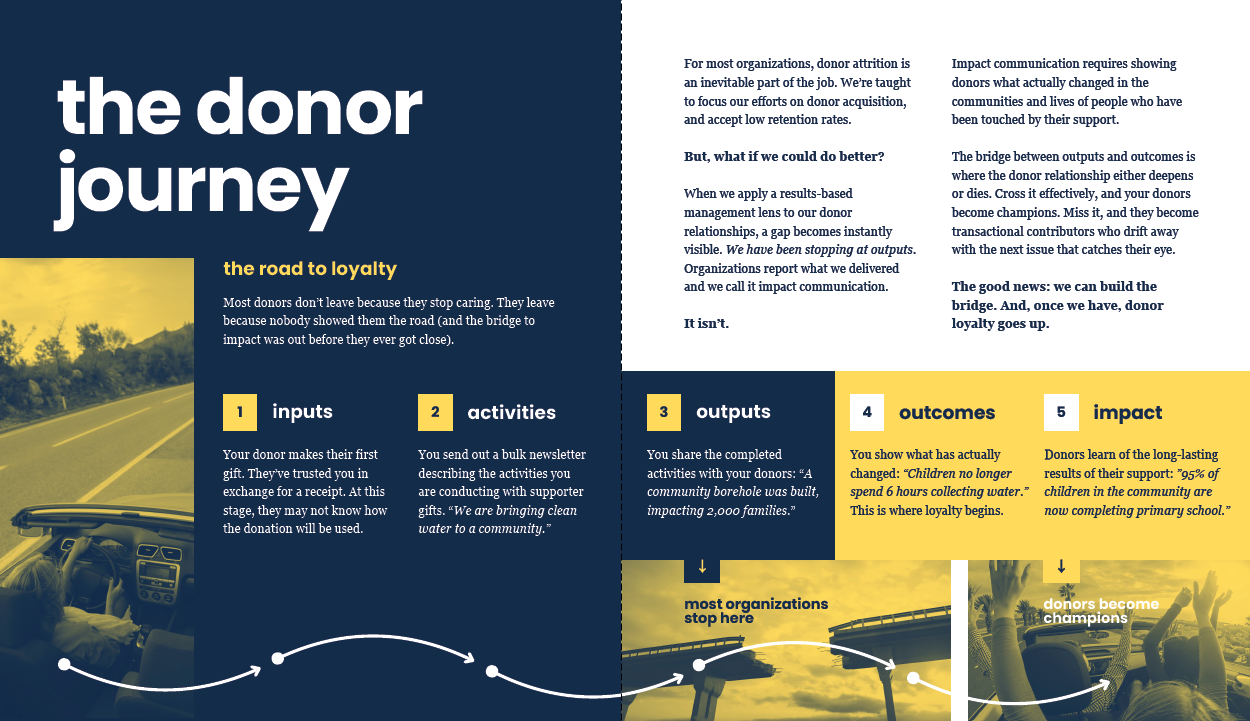
Why it worked: Most organizations have the results chain in their logframes and nowhere near their donor communications. Child sponsorship included it into the model from the beginning. Donors who understand the journey their gift is taking don’t just stay, they trust the organization. They give more. They tell others. The results chain exists in your program design. The question is whether it also exists in your donor communications.
What Sponsorship 2.0 must preserve: Bring donors along the journey. Don’t stop at “your gift helped us build a new water point, reaching 10,000 children”, show them how that has changed the outcomes for those children. Walk them from their contribution to the real-world impact at every stage, not just when someone gets around to it. What could project sponsorship look like for your organization? Perhaps a three-year clean water initiative that a donor could sponsor with monthly gifts. They would receive a welcome pack with a community photo, progress updates twice per year and a letter written by a community member or local project staff. At the end of the third year, they will see the outcome their gifts have made possible, and that moment is an excellent opportunity to invite them to continue their sponsorship to the next project. It’s not child sponsorship, but it follows a similar (but operationally, less intense) process.
What child sponsorship did: Organizations have always understood that a retained child sponsor is an opportunity for a deeper relationship. Birthday and holiday gift appeals. Emergency funds when a crisis hits the community. Community project add-ons that will accelerate progress. These are all natural invitations for donors who are already invested and want their gifts to go further.
Why it worked: These additional gifts worked because the relationship was already warm. The donor knew the community. They followed the progress. They felt connected. The infrastructure that organizations are now cutting to reduce operating costs (photos, field visits, letters, etc.) are the exact tools that kept donors warm enough to respond to these deeper requests for support. You can’t remove the relationship and expect the loyalty to remain. Walking away from child sponsorship without replacing the communication model will result in a double whammy: reduced donor retention and a lower upgrade revenue… both at the same time.
What Sponsorship 2.0 must preserve: Build natural moments for donors to deepen their giving into your retention model. If things are working well (donors feel connected, informed, and part of the journey), they will respond. If it’s not, no amount of upgrade appeals will compensate. Upgrades come out of a strong relationship. You have to get the relationship right first.
Child sponsorship wasn’t one organization’s competitive advantage. It was a model that the entire sector adopted because the results were undeniable. World Vision, Christian Children’s Fund (Children Believe), Foster Parent’s Plan (Plan International), Compassion… they all followed suit, and for the past 70+ years, it has been working.
Sponsorship 2.0 can work the same way. It doesn’t need to be anyone’s secret. It just needs to exist, with a real promise, a real communications structure, and a commitment to showing donors the full journey their gifts are taking.
You don’t have to be the first to get there, but you do have to get there in order to give your donors an experience they’ll want to stick around for.

Your supporters gave you a gift. Show them what it meant.





Field photography was taken during professional program visits across 20+ countries. All individuals pictured have provided consent for the use of their image in materials promoting international development and child welfare programs. Images are used here for educational purposes to illustrate the impact of donor-funded programs.